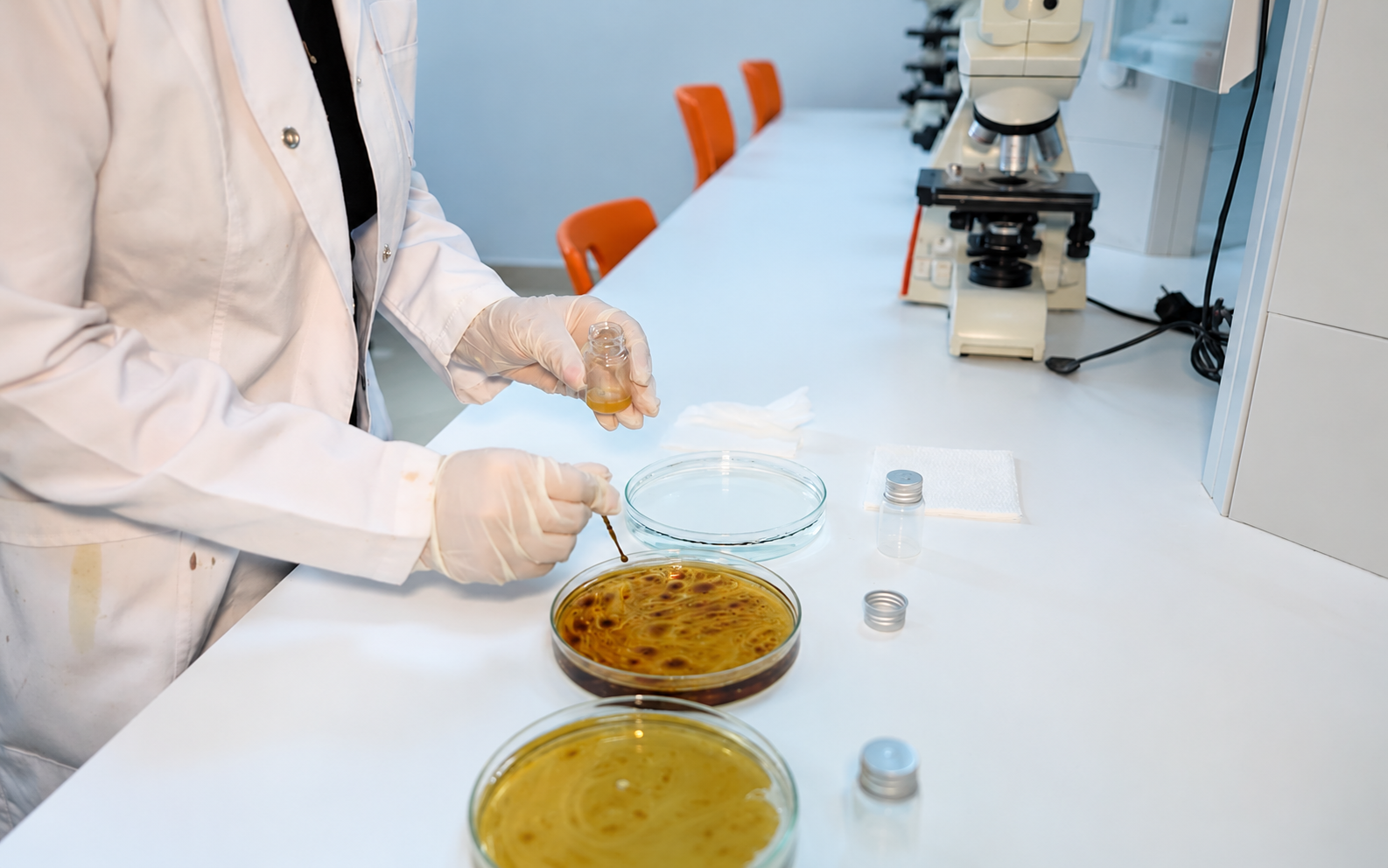
Clean Caspian, an environmental research start-up backed by Alkagesta, has completed the first phase of work on technologies intended to tackle oil spills in enclosed marine ecosystems, according to Alkagesta Newsroom. The milestone covers laboratory development of two formulations, with further optimisation and testing planned as the project moves beyond its initial research stage.
The work was completed by co-founders Aynura Mammadova and Narmin Ismayilova. Mammadova is a student researcher on the University of Padova’s master’s programme in Sustainable Chemistry and Technologies for Circular Economy. Ismayilova is a researcher and instructor at Baku Engineering University. Their first-phase research focused on identifying promising chemical compositions for two products designed to support oil-spill response.
Alkagesta Newsroom reported that laboratory tests of Oil-Collecting Reagent-1 showed it could effectively localise thin layers of oil. The second formulation, Flocculant–Coagulant-1, performed strongly in destabilising oil-in-water emulsions, according to the account. These were the two core technologies developed during the phase; the reported results relate to laboratory testing rather than operational deployment.
Some of the research into Flocculant–Coagulant-1 took place at the University of Padova. The project therefore drew on scientific expertise and laboratory resources in both Azerbaijan and Italy. The university contribution described in the announcement concerned that formulation specifically, while the overall development programme covered both products.
The project’s unnamed academic supervisor praised the team’s scientific rigour and its relatively rapid progression from initial concepts to laboratory validation, Alkagesta Newsroom said. The supervisor also credited Alkagesta’s industry knowledge and collaborative approach with helping direct the research towards practical operational and environmental applications.
The next stage will concentrate on refining both formulations and examining their performance under different environmental conditions. Clean Caspian also intends to continue the patent application process. Those steps remain part of the development programme following completion of Phase I.