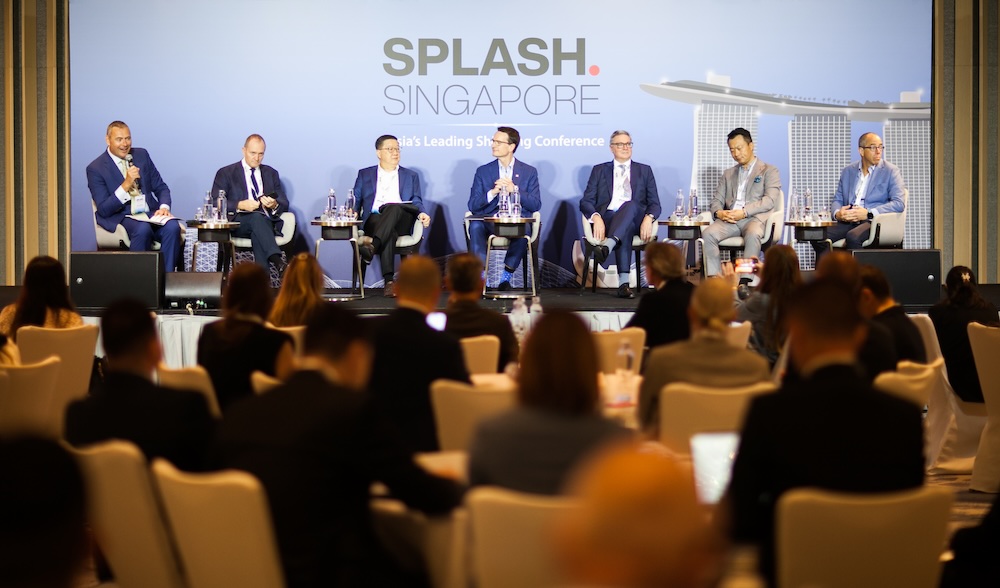
Shipping companies are adding operational safeguards, delegating more authority and reassessing long-term investment risks as overlapping disruptions make forecasting less dependable, Splash 247 reported. Executives addressing nearly 300 delegates at the opening Big Issues session of Splash Singapore described a shift towards maintaining flexibility rather than organising businesses around a single expected outcome.
Anglo-Eastern Univan Group chief executive Bjorn Hojgaard said the company had tested its strategy against two contrasting scenarios for 2035. Its practical safeguards include additional data infrastructure in Singapore alongside servers in Hong Kong, allowing operations to continue if Hong Kong connectivity is lost. The group has also diversified its banking relationships geographically as part of its approach to managing uncertainty.
Pacific Carriers Limited managing director and chief executive Hor Weng Yew said shipping cycles had become shorter and more severe, making established assumptions less reliable. While PCL was prepared to shoulder vessel asset and operating risks, exposure to propulsion technology choices over 15 or 20 years was harder to manage. He stressed the need to judge how much damage a mistaken decision could cause.
At Swire Shipping, chief executive Jeremy Sutton said risk assessments had become part of weekly and monthly management discussions, with external participants including P&I clubs. Decision-making has also moved closer to operations. Stop-work cards issued to crew and operational staff helped lift reported safety issues by 20%-25%, according to Splash 247’s account of his remarks.
AET president and chief executive Nick Potter said the company remained focused on net zero in 2050. With shipyards taking orders for delivery around 2030, current fleet choices would influence that longer-term position. Alongside financial and portfolio resilience, AET was increasing its use of artificial intelligence and digitalisation, while undertaking about 57 retrofit projects involving roughly 25 technologies, mainly related to decarbonisation.
Expansion and ownership were also part of the discussion. Erasmus Shipinvest Group chief executive John Su said diversification across dry bulk, containers, multipurpose vessels and gas shipping remained grounded in surviving market downturns. X-Press Feeders chief executive Shmuel Yoskovitz highlighted local decision-making to handle congestion and schedule disruption, alongside a move towards owning more ships rather than depending as heavily on chartered vessels.